Ditapis dengan

Filsafat Pemidanaan dalam Sistem Pemidanaan KUHP 2023
Kebijakan Penjaminan Tanah dengan Hak Tanggungan Elektronik di Indonesia

Hukum lingkungan internasional

Bunga rampai kewarganegaraan

Empowering adolescent girls in developing countries: gender justice and norm change (e-book)
Adolescence is a pivotal time in a girl's life. The development of educational, physical, psychosocial, familial, political and economic capabilities enable girls to reach their full potential and contribute to the wellbeing of their families and society. However, progress is still significantly constrained by discriminatory gender norms and the related attitudes and practices which restrict girls’ horizons, restrain their ambition and, if unfettered, allow exploitation and abuse. Empowering Adolescent Girls in Developing Countries explores the detrimental impact of discriminatory gender norms on adolescent girls’ lives across very different contexts. Grounded in four years of in-depth research in Ethiopia, Nepal, Uganda and Viet Nam, the book adopts a holistic approach, recognising the inter-related nature of capabilities and the importance of local context. By exploring the theory of gendered norm change, contextualising and examining socialisation processes, the book identifies the patriarchal vested interests in power, authority and moral privilege, which combine in attempts to restrict and control girls’ lives. Throughout the book, Empowering Adolescent Girls in Developing Countries demonstrates how efforts to develop more egalitarian gender norms can enable disadvantaged adolescent girls to change the course of their lives and contribute to societal change. Accessible and informative, the book is perfect for policy makers, think tanks, NGOs, activists, academics and students of gender and development studies.
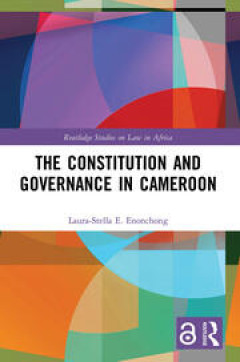
The Constitution and Governance in Cameroon (e-book)
This book provides a systematic analysis of the major structural and institutional governance mechanisms in Cameroon, critically analysing the constitutional and legislative texts on Cameroon’s semi-presidential system, the electoral system, the legislature, the judiciary, the Constitutional Council and the National Commission on Human Rights and Freedoms. The author offers an assessment of the practical application of the laws regulating constitutional institutions and how they impact on governance. To lay the groundwork for the analysis, the book examines the historical, constitutional and political context of governance in Cameroon, from independence and reunification in 1960–1961, through the adoption of the 1996 Constitution, to more recent events including the current Anglophone crisis. Offering novel insights on new institutions such as the Senate and the Constitutional Council and their contribution to the democratic advancement of Cameroon, the book also provides the first critical assessment of the legislative provisions carving out a special autonomy status for the two Anglophone regions of Cameroon and considers how far these provisions go to resolve the Anglophone Problem. This book will be of interest to scholars of public law, legal history and African politics.

Asian socialism and legal change: the dynamics of Vietnamese and Chinese reform (e-book)
Applicable law in investor–state arbitration : the interplay between National and International Law (e-book)

Data rights law 1.0 the theoretical basis key laboratory of big data strategy (e-book)

 Karya Umum
  Filsafat
  Agama
Agama  Ilmu-ilmu Sosial
  Bahasa
  Ilmu-ilmu Murni
  Ilmu-ilmu Terapan
  Kesenian, Hiburan, dan Olahraga
  Kesusastraan
  Geografi dan Sejarah